

The U.S. labor market of 2026 has officially entered the “Agentic Era.” As autonomous AI agents handle routine data entry and basic coding, the premium on human capital has shifted. It is no longer enough to be “tech-savvy.” In a landscape defined by fluctuating interest rates, shifting global trade alliances, and a “low-hire, low-fire” corporate environment, the most valuable asset a graduate can possess is a deep, theoretical understanding of how the world moves.
Mastering economic theory is no longer just for aspiring Wall Street analysts; it is the ultimate “power move” for any 2026 graduate looking to navigate a volatile economy.
The 2026 Economic Landscape: A High-Bar Reality
According to recent labor statistics and U.S. Federal Reserve projections for 2026, the demand for “analytical reasoning” has outpaced “technical execution” for the first time in a decade. Employers are looking for individuals who can interpret the why behind the numbers. When a new tariff is announced or a decentralized finance (DeFi) protocol shifts market liquidity, a business needs staff who understand the secondary and tertiary effects—the essence of macroeconomic theory.
For many students, bridging the gap between classroom theory and these real-world applications is the hardest part of their final year. The complexity of modern academic standards means that a simple summary is no longer enough to secure a top grade. This is why many students seek professional support through a reliable economics essay writing service to ensure their work meets the rigorous E-E-A-T (Experience, Expertise, Authoritativeness, and Trustworthiness) standards required by top-tier U.S. universities. By collaborating with experts at myassignmenthelp, graduates can refine their understanding of complex models like Solow-Swan or Game Theory, ensuring their academic portfolio reflects the high level of sophistication that 2026 recruiters demand.
The Skill-to-Salary Bridge: Why Theory Pays
In 2026, the “Skill-to-Salary Bridge” is built on the foundation of specialized knowledge. While generalists are struggling with the automation of entry-level roles, those who can apply economic frameworks to business strategy are seeing a 15-20% higher starting salary in sectors like FinTech, Green Energy, and Healthcare Administration.
1. Navigating the “Low-Hire” Market
The 2026 U.S. job market is characterized by selectivity. Companies are hiring fewer people but paying more for high-level thinkers. Economic theory provides the “mental models” needed to solve problems that AI cannot—such as predicting consumer behavior during a period of “stagflation lite” or understanding the social cost of carbon in a green economy.
2. Strategic Decision Making
Every major business decision is an economic one. Understanding Opportunity Cost, Marginal Utility, and Market Equilibrium allows a graduate to contribute to high-level meetings on day one. When you understand the “why,” you become indispensable.
E-E-A-T in Academic Writing: The Competitive Edge
The Department of Education’s 2026 report on Higher Education highlights a growing trend: “Authentic Assessment.” Professors are moving away from multiple-choice tests and toward deep-dive essays that require original thought and data-driven analysis.
If you are struggling to balance your internship with these heavy research requirements, you might look for an essay paper for sale to use as a benchmark for your own research. Utilizing high-quality references and professionally structured papers can help you understand how to cite sources like the Bureau of Economic Analysis (BEA) or the International Monetary Fund (IMF) correctly, which is vital for maintaining academic integrity and boosting your own expertise.
Data-Driven Insights: The 2026 Outlook
Source: 2026 Global Economic Productivity Report
| Economic Concept | Real-World Application (2026) | Salary Impact |
| Behavioral Economics | Consumer UX & AI Personalization | +12% |
| Econometrics | Predictive Supply Chain Analytics | +18% |
| Environmental Econ | Carbon Credit Trading & ESG Compliance | +22% |
| Game Theory | Competitive Tech Pricing & Negotiations | +15% |
 Key Takeaways for 2026 Graduates
- Theory is Defensive: In an automated world, the ability to think critically using economic models protects you from displacement.
- Data is the Currency: Every argument must be backed by credible sources (BLS, OECD, Fed Reports).
- E-E-A-T Matters: Whether in a blog, a term paper, or a corporate report, demonstrating expertise and authority is the only way to build trust.
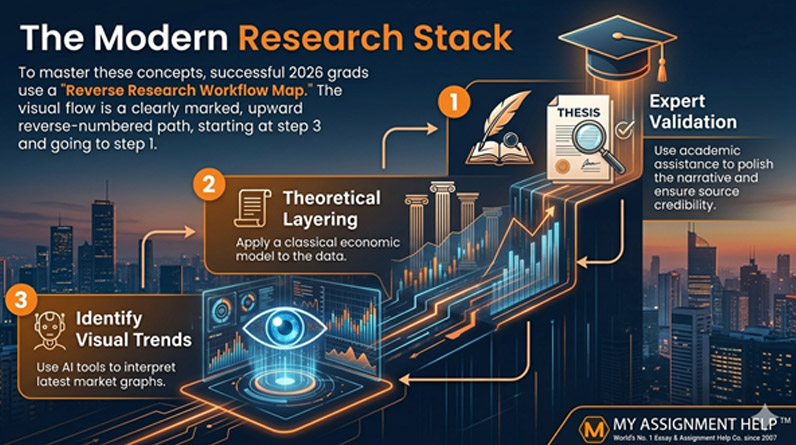
- Balance is Strategic: Use available resources—from AI image analyzers to professional writing services—to manage your “Academic ROI.”
FAQ Section
Q1: Is economic theory still relevant with the rise of AI?
A: More than ever. AI can calculate data, but it cannot “understand” the socio-political nuances of economic shifts. Humans are needed to interpret AI output through the lens of theory.
Q2: How can I improve my economics grades in my final semester?
A: Focus on “Data-Driven” writing. Use real-time sources from 2025 and 2026. If the workload is too high, seeking expert guidance can help you understand complex topics faster.
Q3: What are the highest-paying economics niches in 2026?
A: Environmental Economics (ESG), Behavioral Economics for Tech, and Health Care Econometrics are currently seeing the highest demand in the U.S. market.
Author Bio
Marcus Thorne is a Senior Content Strategist at myassignmenthelp with over a decade of experience in academic consulting and SEO. Holding a Master’s in Applied Economics, Marcus specializes in bridging the gap between complex academic theories and practical career outcomes. He is a frequent contributor to educational forums, focusing on the impact of AI on the 2026 labor market and helping students achieve E-E-A-T compliance in their professional and academic writing.
References
- U.S. Bureau of Labor Statistics (BLS) – 2026 Occupational Outlook Handbook.
- Federal Reserve Board – Monetary Policy Report (February 2026).
- Journal of Economic Perspectives – “AI and the Marginal Productivity of Human Thought” (2025).
- Higher Education Strategy Associates – “The Evolution of Authentic Assessment” (2026).