

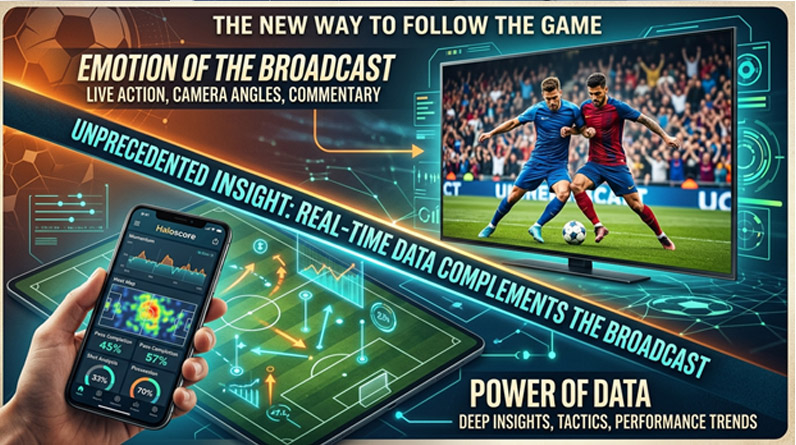
At some point in time, I used to be of the opinion that watching a match involved one and the same process – sitting down and following all the stages of a broadcast. However, my position has shifted considerably over time. Nowadays, I use real-time match data as actively as the video feed itself, if not more.
My opinion does not imply rejection of the idea of watching sports. However, it allows realizing that data provides something that is unavailable to the mere broadcasting.
What Real-Time Data Actually Offers
A broadcast shows me what happens on the pitch. However, data allows interpreting this information. Possession, shot statistics, substitution times, and match momentum – all these numbers help me understand the meaning of the events.
For example, the real-time data allow me to understand if the substitution is made for defensive, tactical, or fatigue reasons. In case if one of the teams suddenly starts putting pressure on another one, statistics help me determine if it is a real pressure which produces chances or an illusion.
Therefore, such platforms as haloscore are rather helpful for me. They give me a way to follow the numbers behind the match, not just the visuals.
With time, it has become clear that these statistics affect the way I view the match being played. A team which appears strong on screen may actually be having problems turning possession of the ball into scoring opportunities. This is something that I can always tell from the statistics much quicker than from the commentary.
Furthermore, it is now possible for me to see trends in the performances of teams by looking at the statistics from match to match, rather than from one match only.
Solving the Problem of Limited Attention
I cannot always watch a full match with complete focus. Sometimes I am working, studying, or handling something else entirely. Real-time data solves a real problem here. It lets me stay informed even when I cannot give the broadcast my full attention.
A quick glance at match data tells me whether I am missing something important. If nothing significant has changed, I can continue with what I am doing. If the numbers shift suddenly, that is often a signal worth checking in on.
This has become especially useful during matches that start slowly. Instead of forcing myself to watch a quiet first half out of obligation, I can check in periodically and only commit my full attention once the data suggests the match is opening up.
There have been plenty of afternoons where I kept a match running quietly in the background, only pausing what I was doing when a shift in momentum or an unexpected statistic caught my attention. That kind of selective focus would not be possible without real-time data guiding the decision.
As a sports analyst, this habit has become almost professional in nature. I treat data checks the way I would treat scanning headlines, quickly filtering out matches that are not producing anything notable so I can focus my limited time on the ones that actually matter.
Comparing Data to the Broadcast Experience
The broadcast still matters. Commentary, camera angles, and live action create an experience that numbers alone cannot replace. But comparing the two, I have noticed that data often gives me a clearer understanding of how a match is actually being controlled.
A broadcast can make a match look chaotic or one-sided based on a few dramatic replays. Data tends to be more consistent. It reflects patterns over the full ninety minutes rather than isolated highlights.
Checking real-time match updates alongside the broadcast has become part of how I evaluate what is actually happening, rather than relying only on commentary or visual impressions.
I have found this combination particularly useful when a commentator’s narrative does not quite match what the numbers suggest. Data gives me a way to question assumptions rather than simply accepting whatever story the broadcast is telling in the moment.
This does not mean commentary is unreliable. It simply means data gives me an additional reference point, something I can weigh against what I am hearing rather than accepting at face value every time.
Why This Balance Matters
I do not think data should replace watching the game. The two work best together. Data adds structure to what I am seeing, while the broadcast adds emotion and immediacy that numbers cannot capture on their own.
This balance solves a problem many fans face: wanting to stay deeply informed without always having the time or ability to watch every minute of every match.
It also helps me prioritize which matches deserve more attention on a busy day. If the data suggests a match is becoming tactically interesting or unusually close, that is often enough to convince me to shift my focus toward the broadcast itself.
A Shift in How I Value Match Information
Looking back, my relationship with sports has changed because of this shift. I used to think broadcast access was the most important part of following a match. Now I see it as one part of a larger picture that includes data, timing, and context.
Real-time information has become just as valuable to me as the footage itself. It helps me understand matches more completely, especially on days when I cannot watch from beginning to end.
As my own habits continue to evolve, I expect data to remain a core part of how I follow sports, not as a replacement for the broadcast, but as an equal partner to it. The two together give me a more complete picture than either one could provide alone, and I doubt I will ever go back to following a match without both.
I have also noticed that this habit changes how I talk about matches with other fans. Instead of only describing what happened, I find myself explaining why it happened, referencing possession trends or shot patterns that came directly from data I checked during the game rather than something I picked up afterward from a highlight reel.
None of this replaces the simple joy of watching a great match unfold. It only adds another dimension to how I experience it, one that fits naturally into a life where I rarely have the luxury of watching every single minute without distraction.
Looking at how my own understanding of matches has deepened, I credit real-time data more than any single broadcast I have watched. Numbers, tracked consistently over time, have taught me more about how football actually works than commentary alone ever did.
I suspect this shift will only deepen as more detailed data becomes available. The more context I have access to, the less satisfied I feel with a bare scoreline, and I do not expect that feeling to reverse.