

In May 1740, on a flat stretch of ground beside the River Tay at Aberfeldy, near the fine new bridge General Wade had built to carry his road north, about a thousand men were formed into a regiment.
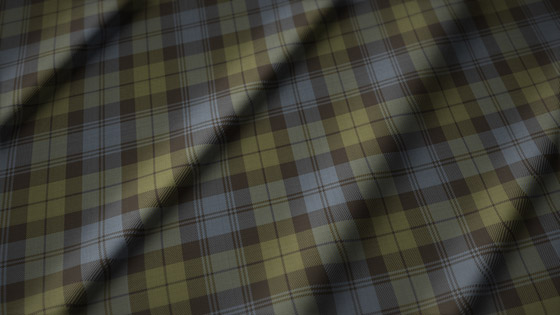
They were not new to soldiering. For fifteen years, since 1725, Independent Companies of Highlanders had been patrolling the glens for the government, keeping the peace, disarming the clans and watching the cattle thieves. There had been six companies at first, then ten, and the Highlanders had a name for them. Because the redcoats of the regular army were Saighdearan Dearg, the red soldiers, and these men wore a dark tartan of blue, green and black, they were Am Freiceadan Dubh. The Black Watch. That dark cloth has since been faded on purpose into the softer Black Watch Weathered tartan, which looks the way their plaids must have looked after a few winters.
At Aberfeldy the companies became a regiment of the line, the 43rd of Foot, later renumbered the 42nd, and the dark tartan they had worn as a police force became a uniform. There is a monument on the spot now, put up in 1887, with a kilted soldier of 1740 on top of it looking down the river. Historians still argue over whether the name meant the dark cloth or the dark business of policing one’s own people, and the honest answer is probably both. It is the oldest of all regimental tartans, and it has been worn in every war the British Army has fought since.
Twelve yards, and what they were for
What the men were wearing at Aberfeldy was not a kilt as we know it. It was the belted plaid: a length of tartan cloth, four to six yards long and double width, laid on the ground, pleated by hand, and then belted round the waist with the wearer lying on top of it, so that the lower half hung as a kilt and the upper half could be drawn up over the shoulders as a cloak, pinned at the breast, or thrown over the head against rain. Getting into one was a skill. Getting out of one was quicker.
And at night the plaid was the bed. A Highlander on campaign or on the hill unbelted his plaid, wrapped himself in the whole length of it, and lay down in the heather. The cloth was thick, tightly woven, oiled by wear and by the natural grease of the wool, and it turned rain and held warmth. Travellers in the Highlands recorded with astonishment that the men would soak the plaid in a burn before sleeping in it on a cold night, because wet wool against the skin, wrapped tight, held a layer of warmed air that dry wool did not. There are accounts of Black Watch sentries in the American winter of 1757, at Albany, sleeping in the snow in their plaids while the regulars froze in their blankets.
So the tartan blanket is not a Victorian invention for the picnic. It is the oldest use of the cloth. The kilt is what the plaid became when a man wanted the bottom half without the top.
The colour of weather
Government tartan, as the Black Watch sett is properly called, is very dark: a navy blue so deep it reads as black, a bottle green, and black lines between them. It was chosen to be dark. A watch on the hills at night in bright red would not have lasted long.
But dark cloth, worn in the open for years, does not stay dark. The blue fades towards a soft grey-blue, the green towards a mossy olive, the black towards brown. A Black Watch plaid that had been slept in for three winters would have looked nothing like a new one. That is the look that the weathered colourway sets out to reproduce.
Tartans today are woven in several standard colourways from the same thread count. Modern colours are the strong chemical dyes of the nineteenth century onwards. Ancient
colours are lighter, imitating the vegetable dyes of the eighteenth. Weathered, sometimes called muted or reproduction, imitates old cloth that has been out in the rain and sun for a long time: the blue goes slate, the green goes to lichen and moss, the black goes to a warm brown. On most tartans the effect is pleasant. On the Black Watch it is transforming. The sternest tartan in Scotland becomes a soft, earthy, countryman’s cloth, the colour of a hill in November, and it goes with tweed and leather in a way the Modern never quite does.
It has another quality, which the men at Aberfeldy would have understood. Weathered cloth hides wear. A kilt in Modern Black Watch shows every scuff and every fade; a kilt in the Weathered has, in a sense, already faded, and a decade of use only makes it more itself. That is why it is the colourway most often chosen by men who intend to wear a kilt rather than keep one. It works the same way off the body, which is why the weathered sett appears among celtic rugs and throws, where it looks at home from the first day.
Retailers offer Black Watch Weathered tartan alongside the Modern and Ancient, made to order as kilts, skirts, scarves and ties, or by the yard. The Black Watch is a universal tartan: it belongs to a regiment, not a clan, and anyone may wear it, which is why it is the most worn tartan on earth.
The Laurentians, a Friday in January
Guy Tremblay-Ross is sixty-one and served for nine years in the Black Watch (Royal Highland Regiment) of Canada, the Montreal regiment that has carried the name and the tartan since 1862 and is the oldest Highland regiment in the country. His mother’s people were Rosses from Tain who came to Quebec in the 1850s. His father’s people were Tremblays, of whom there are a great many. He parades on Remembrance Day in the kilt and spends most of the rest of his time at a cabin in the Laurentians, two hours north of Montreal, where in January the temperature at night is thirty below.
The cabin has a wood stove and a draught, and the draught wins. His daughter, who is thirty and worries, had been looking for something for the sofa that was warm enough to be worth having and not so heavy that her father, who has a bad shoulder, would refuse to pull it over himself.
She found what she wanted at Scottish Kilt, which makes the family’s kilts, in a small range of tartan throws, blankets and travel rugs filed under celtic rugs and described in a sentence she liked: warmer for their weight than you expect, and without the itch of heavier cloth. There is a throw big enough for a sofa or the foot of a bed, and a bed runner, in clan, district and fashion setts, and she ordered the throw in the Black Watch Weathered, on the grounds that her father had worn the Modern for nine years and would want to see the difference.
It arrived in three weeks, folded in tissue, in slate blue and moss green and brown, with a fringe. It weighs very little, which is the point of a fine worsted over a heavy blanket weave: the warmth is in the density of the yarn, not the thickness of the cloth, and there is none of the itch of the coarser wools. On the night she brought it up, with the stove roaring and the draught coming under the door as usual, he pulled it over his legs, read for an hour, and did not get up to fetch the sleeping bag.
“It’s the old colour,” he said, without looking up. “This is what the plaids looked like after a couple of winters. They used to say you could tell a veteran by the colour of his kilt.”
“Is it warm enough?”
“They slept in this in the snow, at Albany, in 1757. Before there was a Canada.” He turned a page. “Wet. They’d wet it first.”
“I’m not wetting the throw, Dad.”
“I’m not asking you to. I’m telling you what the cloth was for.”
He fell asleep in it, on the sofa, with the book on his chest, and she left it on him and went to bed.
Am Freiceadan Dubh
The regiment that mustered at Aberfeldy in 1740 was formed of men who had spent fifteen years sleeping on hillsides in the cloth they wore, and the dark tartan they made famous was a bed before it was a uniform. The weathered colourway is a way of remembering that: it is the Black Watch as it looked on a man who had used it.
A throw in those colours, light enough for a bad shoulder and warm enough for thirty below, on a sofa in a cabin in the Laurentians, is closer to what the cloth was for than any kilt at any wedding. The plaid was the bed. It still works.